
BJJ Training Journal: What to Record After Every Session
DON’T JUST REMEMBERTHE ROLL.LEARN FROM IT.
A useful BJJ training journal shouldn’t become a graveyard of notes you never read again.
After training, record what worked, where you struggled and the lesson you want to carry forward. Add the date and enough session context to recognize the entry later. Before your next class, reread it and choose one question or intention to take onto the mats.
01 / Capture it
What should you write in a BJJ training journal?
Use these three prompts. Write enough to recognize the situation later—not a transcript of the entire class.
A reusable jiu-jitsu training journal template
Date / gi or no-gi / session focus: ______
SHARP — What worked?
Name one thing you noticed doing well and the situation in which it happened.
NEEDS WORK — Where did you struggle?
Describe a position, decision or unanswered question rather than rating your whole session as bad.
LESSON — What are you taking into the next session?
Choose one point to revisit or ask your coach about.
Copy the prompts into whatever you already use. No account, download or ATLAS subscription is needed to use this template.
02 / Make it specific
“GOOD ROLLS” DOESN’T GIVE YOU MUCH TO REVISIT.
The entry below is fictional. It illustrates reflection, not technical instruction or a real athlete’s result.
Session: Tuesday, no-gi; positional rounds from guard.
Sharp: I remembered the question I brought to class and asked it before rolling. I left with a clearer cue from the coach.
Needs work: Once the rounds opened up, I lost track of that cue and returned to the same reaction.
Lesson: Before the next positional round, ask the coach what I should notice first. Write their answer in my own words afterward.
The entry leaves you with something to do. You do not have to count every exchange or turn your partners into a win-loss spreadsheet.
03 / Carry it forward
THE VALUE ISN’T THE NOTE. IT’S WHAT YOU DO NEXT.
Your last session should help shape your next one. Before class, skim the previous entry and choose a single intention: a question to ask, a position to understand or a detail your coach asked you to notice.
Afterward, return to that intention. Was it addressed? Is it still unclear? Did a different problem appear? A lesson can remain a question; you do not need to manufacture a breakthrough after every session.
If the same difficulty appears repeatedly, bring the entries into a conversation. Useful coaching context starts with a clear question, not a larger pile of measurements.
04 / Reflect on the pattern
Keep the details that change the next decision.
- Capture close to training when practical. If you cannot write immediately, leave a short cue and finish the thought when you can.
- Review several entries together. Look for a repeated question, a focus that never reaches live rounds or a cue that is becoming easier to remember.
- Separate observation from interpretation. “I stopped attempting it after the first round” is an observation. Why that happened is something to investigate.
- Keep context proportionate. Note a changed session or unusual tiredness if it explains what happened. Avoid recording other people’s personal information.
A training log records what you did. A reflection records what you noticed and want to do with it. You can keep both brief.
The connected ATLAS story
DON’T LET TRAINING DISAPPEAR WHEN THE SESSION ENDS.
ATLAS PI Premium includes Camp Journal in Analytics for an active camp, with structured Sharp, Needs work and Lesson reflections. Training, recovery context and camp history live in the wider preparation system.
To use that product workflow, sign in with Premium, create or select your camp, then open Analytics → Camp Journal → Add reflection. Personal reflections stay private; camp reflections have sharing controls for permitted coaches.
The template above works whether or not you have a camp or use ATLAS. In the app, the value is keeping reflection within the preparation you are already reviewing—not claiming that a note automatically fixes technique or changes your plan.
Explore the connected Premium workflow →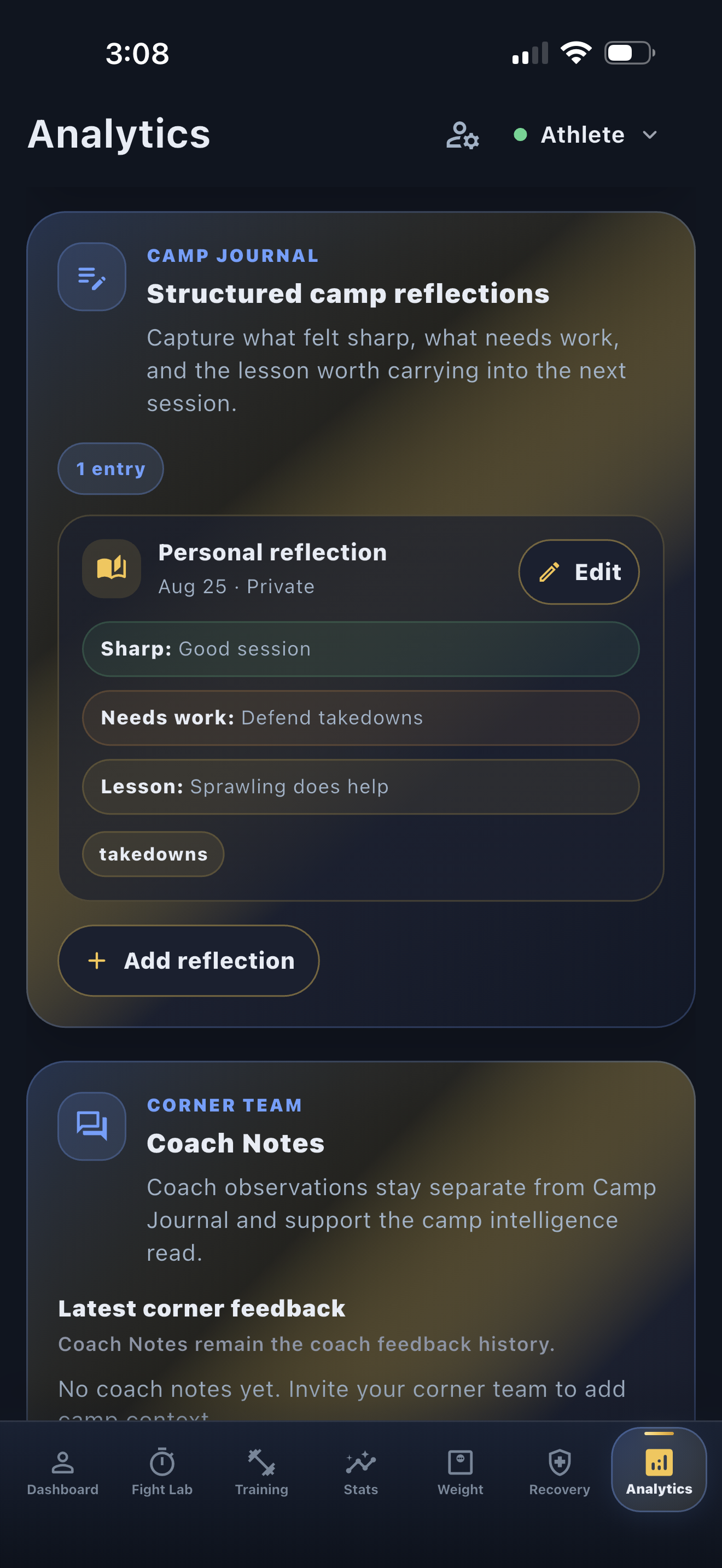
Before you go.
Do I need a special notebook or app?
No. Start with paper or a notes app you already open. Use the same prompts so entries are easy to revisit. The template on this page is free to use.
Should I write down every technique?
Not for this short reflection method. Capture the detail that matters to your next session and any question you need your coach to clarify. A separate technique reference can serve a different purpose.
Can I use this outside fight camp?
Yes, the template works after ordinary BJJ training. ATLAS PI’s Camp Journal product workflow requires an active camp and Premium; those requirements do not apply to using the template yourself.
Will ATLAS automatically analyze my rolling or correct technique?
This journal workflow is structured reflection, not automatic rolling-video analysis or technique correction. Ask your coach about technical questions.