
Muay Thai Training Schedule: Build Your Weekly Plan
DON’T JUST TRAIN HARD.MAKE THE WEEKMAKE SENSE.
Build a Muay Thai training schedule around your actual life, recovery, priorities and fight preparation.
Start with the classes and commitments you cannot move. Choose the purpose of your training week, identify the demanding sessions with your coach, and leave space to recover. Add supporting work only where it fits. Then record what you actually did before planning the next week.
01 / Plan the week
How to build a Muay Thai training schedule you can actually follow
- Put fixed commitments on the calendar. Include work, travel, family and your gym’s class times. Count the journey to the gym too. A 90-minute class does not occupy only 90 minutes of your day.
- Name the week’s priority. Is it consistent attendance, a technical focus agreed with your coach, or preparation for a booked fight? Give each planned session a reason to be there.
- Mark the demanding sessions. Ask what the class will involve rather than assuming every session is equally hard. Include strength or conditioning work you already do; it is not separate from the week’s demands.
- Protect recovery and ordinary life. Put rest and realistic sleep opportunities in the plan. Do not treat every empty calendar slot as permission to add training.
- Decide what can move. If work runs late, which supporting session can change? Agree priorities before a missed session becomes an excuse to cram two into tomorrow.
Write the plan in a notebook, calendar or app. The useful part is seeing the whole week and its tradeoffs—not which tool holds it.
02 / Make it concrete
An example week around three fixed classes
This fictional athlete already attends Monday, Wednesday and Saturday classes and has one coach-agreed strength session. The table shows how to organize those commitments. It does not prescribe this frequency or these activities for you.
| Day | Existing commitment | Planning decision |
|---|---|---|
| Mon | Muay Thai class | Take this week’s technical question to the coach. |
| Tue | Existing strength session | Check its demands alongside Wednesday’s class. |
| Wed | Muay Thai class | Record what the class actually involved. |
| Thu | No scheduled training | Keep the space; do not automatically fill it. |
| Fri | Late work shift | Plan around the constraint, not around an imaginary free evening. |
| Sat | Muay Thai class | Confirm the session focus and flag changed recovery to the coach. |
| Sun | No scheduled training | Review the week and sketch the next one. |
If you only have two reliable training windows, plan those honestly. If you have more, that alone does not establish how many sessions you should do.
03 / Log what happened
A MISSED SESSION IS INFORMATION. NOT A DEBT.
Write down the difference between the plan and the week you actually lived. A skipped session, a class that ran harder than expected or a late shift can all change the next decision.
- A session was missed: decide whether its purpose still matters this week. Do not automatically double tomorrow’s work.
- The class was more demanding: review the next planned session with your coach rather than treating the calendar as an instruction you cannot question.
- The same conflict keeps returning: change the schedule. A recurring Wednesday work clash is a planning constraint, not a motivation problem.
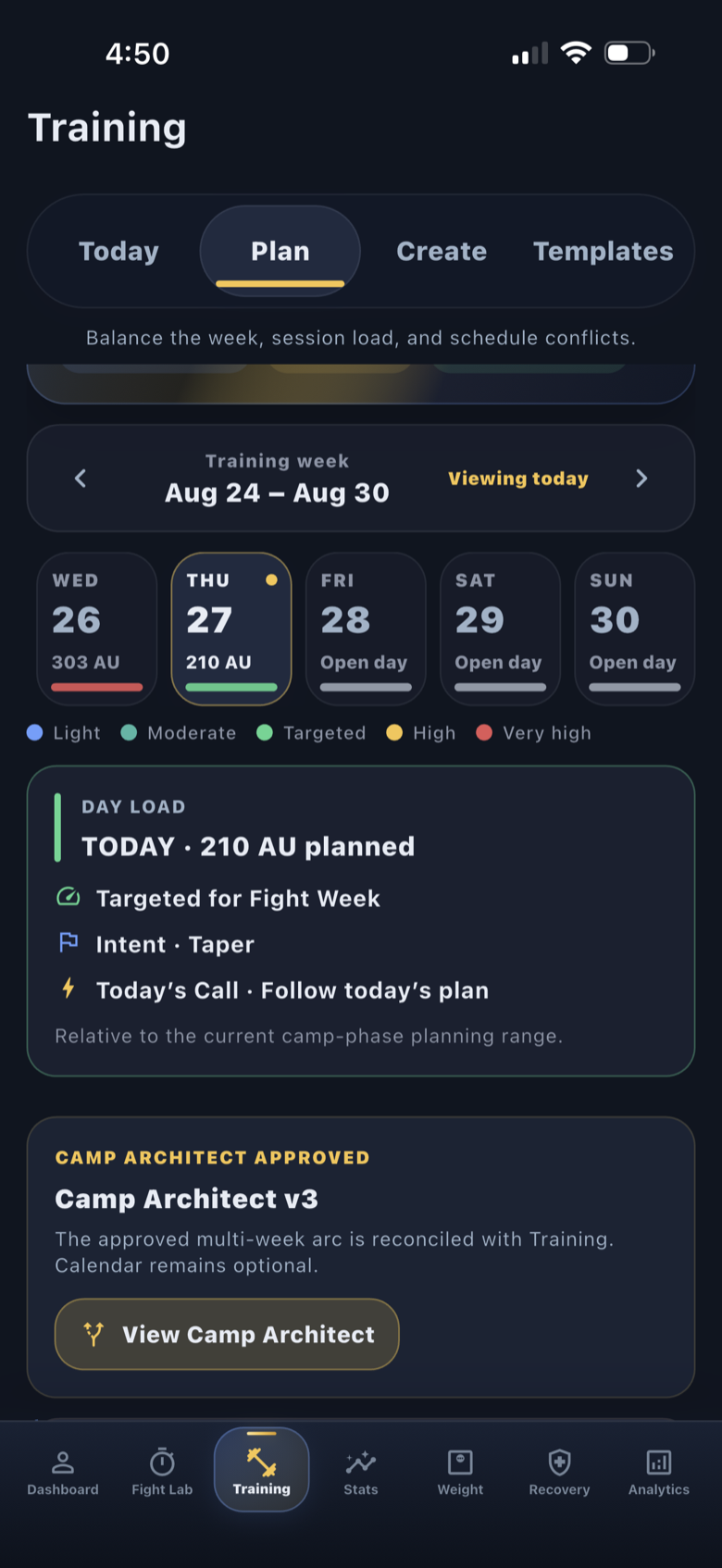
Use this session-adjustment sequence when the day changes, and look at training load across the week rather than judging one session alone.
04 / Adjust what comes next
The weekly check worth keeping.
Copy into your calendar or notebook
- Priority: What is this week meant to move forward?
- Fixed sessions: Which classes can I realistically attend?
- Context: What else is demanding time or recovery?
- Actual work: What did I complete, change or skip?
- Next decision: What stays, moves or needs a coach’s input?
You do not need a perfect week to learn from it. You need an honest record and one clear adjustment.
The connected ATLAS story
A SCHEDULE TELLS YOU WHAT’S NEXT. A CAMP TELLS YOU WHY.
A fight date adds a reason for the weeks to fit together. Your coach’s priorities, available sessions and the work already completed matter alongside what is still planned. Ordinary training and fight camp are related, but they are not the same planning problem.
In ATLAS PI Premium, Training shows the plan and lets you record Completed, Partial or Skipped work. Camp Architect proposes camp plans and revisions for review before they are applied. Recovery context sits within the same preparation system.
That gives you and your coach something concrete to review. It does not replace coaching, prescribe one correct schedule for every athlete or grant medical clearance.
Plan the week. Do the work.
Log what happened. Adjust what comes next.
Before you go.
How many days a week should I train Muay Thai?
There is no single number this guide can choose for you. Start with your current experience, goals, reliable class access and recovery, then agree a suitable frequency with your coach. The example week organizes existing sessions; it is not a recommendation to add them.
Can I use a professional fighter’s schedule?
Use it to understand what their preparation involves, not as a workload to copy. Their training history, coaching, available time and recovery support may be different from yours.
Does this include a complete strength or conditioning program?
No. This is a weekly organization framework. Exercise selection, dosage, sparring and individual fight preparation need appropriate coaching.
General training-organization education, not an individualized coaching or medical prescription. Pain, illness or injury concerns need qualified professional guidance—not a calendar adjustment alone. Training and health disclaimer.
Evidence and scope
This source supports considering training and non-training demands together. It does not validate the illustrative week or endorse ATLAS PI.